.png)
 2 hours ago
2
2 hours ago
2
With Iran negotiations being the key concern of markets at the moment, though without much information to act on, UBS’s Paul Donovan is warning investors against reacting to hints and rumors.
A fragile ceasefire still holds, despite the U.S. launching self-defense strikes against Iran over the weekend. Despite the major impact that tensions in the Middle East are having on inflation worldwide, Donovan said there is an "embarrassing lack” of economic information about the Strait of Hormuz.
This “leaves markets prey to idle speculation, rather than the pure and objective guidance that economists can offer…[The] exchange of fire between Iran and the U.S. has not had a major market impact—it fits with Iran’s narrative on negotiations (which is what markets have priced), and keeps the optimism bias more or less intact.”
ONE BIG THING
Jane Fraser Tops the Fortune Most Powerful Women List
The Fortune Most Powerful Women list is back for its 29th year and, for the first time since 2024, we have a new No. 1.
Citigroup chair and CEO Jane Fraser has ascended to the top spot, five years after she got Citi’s corner office. Fraser broke Wall Street’s glass ceiling when she became the first female CEO of a major bank in 2021.
Fraser, a former McKinsey partner, sat down with Fortune’s Claire Zillman to discuss the dramatic five-year turnaround she has overseen at Citi. Four years ago, the banking giant was in a bad place: Its stock had dropped 15% during Fraser’s tenure, and it was the only big U.S. bank trading below its book value.
The new CEO was clear: The organization was not living up to its full potential, but she had a turnaround plan to fix it. Following 20,000 layoffs, 14 markets exited, and a new, flatter structure, Citi delivered its highest quarterly revenue in a decade in April 2026.
“I never had a lack of conviction,” Fraser tells Fortune. “This was the right path.”
LABOR
Wage growth is struggling to keep up with inflation
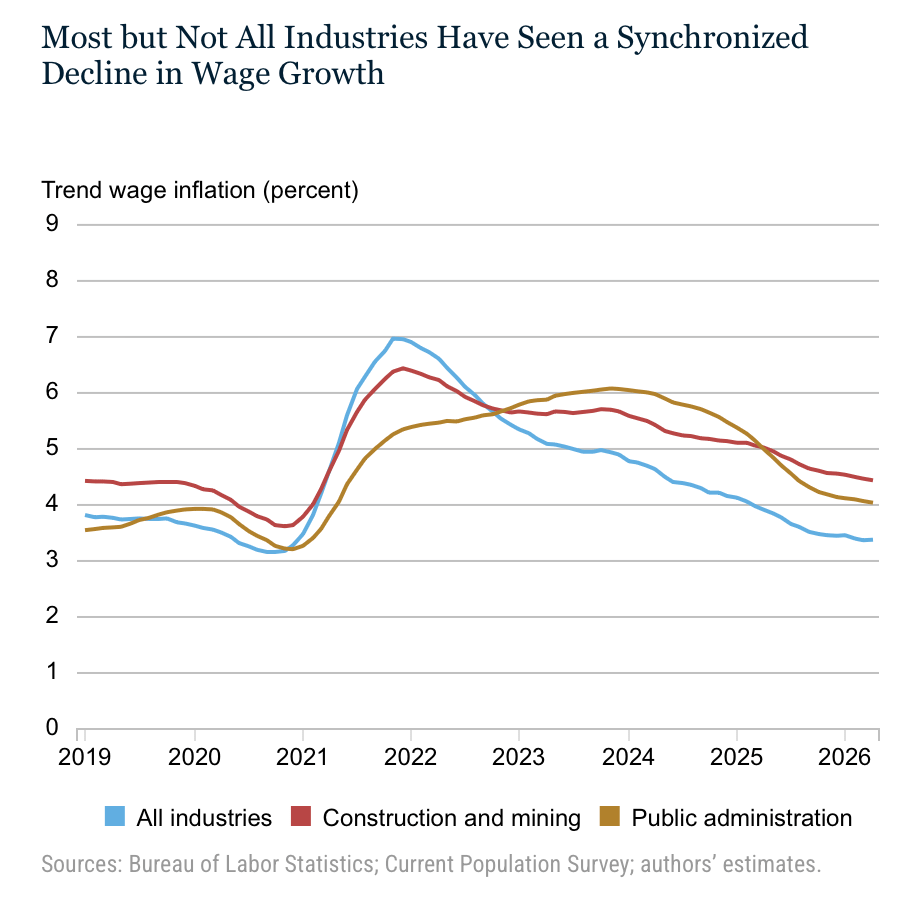
With the exception of a couple of sectors, wage growth in the U.S. is struggling to keep pace with inflation—meaning workers in the majority of industries are relatively worse off.
The New York Fed’s latest wage inflation report found that most, but not all, industries have seen a synchronized decline in wage growth since October 2022, with the notable exceptions of two sectors: public administration and mining and construction.
The mining and construction sector has been more consistent and persistently stronger than the rest of the economy, adds the regional Fed bank, which could be related to the construction of AI data centers, with sustained demand fueling wage growth.
The paper, written by three New York Fed economists (Martín Almuzara, Richard Audoly, and Davide Melcangi) concludes that, looking ahead, “considerable uncertainty remains.” They explain: “On the one hand, specific industries such as construction may continue to put some upward pressure on wage inflation, as they have done in recent months.”
“On the other hand, any deterioration of labor market conditions could result in renewed downward pressure on wage inflation.”
MORE FROM FORTUNE
- Pope Leo’s ‘AI encyclical’ says a lot. But critics say it misses the mark - by Jeremy Kahn
- America’s manufacturing Achilles’ heel: McKinsey’s warning on rare earths grows louder - by Nick Lichtenberg
- This billionaire is capping his kids’ inheritance at 8 figures—like Bill Gates, he thinks generational wealth is bad for society - by Orianna Rosa Royle
- America is becoming less neighborly, and it’s hurting Gen Z and millennials’ chances at economic mobility - by Tristan Bove
CHART OF THE DAY
A hint of optimism
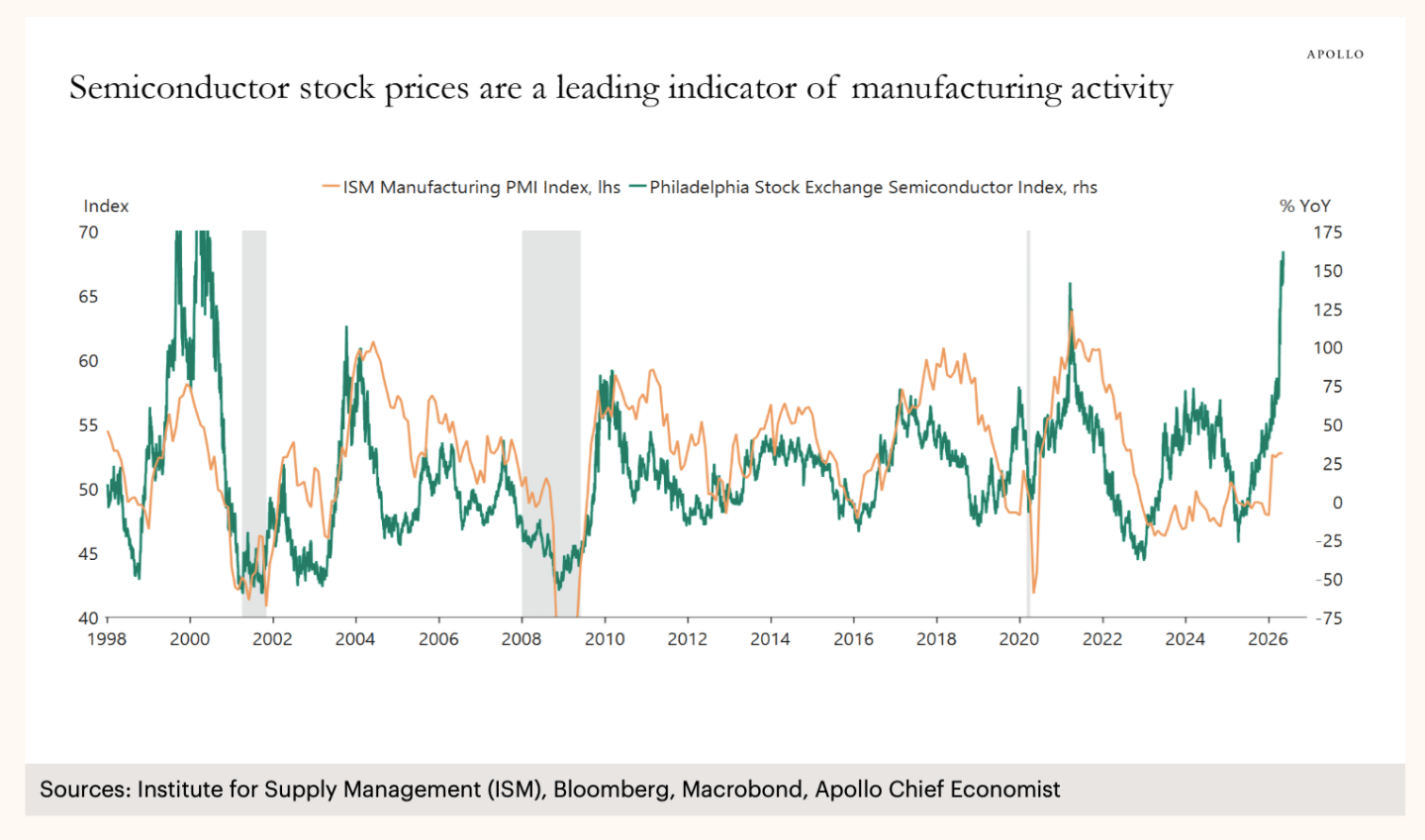
Torsten Slok at Apollo has some good news for us: Chip demand is soaring. This is a precursor to a manufacturing boom, writes Slok, because chips go in everything from cars to phones to kitchen appliances.
If demand for chips increases, it suggests that manufacturers are getting ready for a big push themselves. He wrote in a note accompanying his graph: “When manufacturers plan to ramp up production, they order semiconductors first, often 6-12 months in advance due to long lead times.”
“Chip demand therefore anticipates broader manufacturing demand.”
NUMBER OF THE DAY
$6 trillion
The value of active and passive funds under management, which are benchmarked to the Russell 1000/2000/3000 and Russell 1000 Growth/Value indices. After markets close on Friday, the FTSE Russell's U.S. indices will be reconstituted.
Goldman Sachs wrote in a note this week that capital goods will experience the largest increase in representation, and semis and semi-equipment will continue to carry the largest weight in the index (17%) followed by tech hardware (10%).
Based on Russell’s preliminary results, 62 companies are expected to graduate to the 1000 index—most of which will have migrated from the 2000. With the largest stocks in the Russell 2000 advancing upwards, Goldman told clients the index will exhibit slower growth and higher valuations relative to the current largest stocks in the small-cap index.
THE FRONT PAGES TODAY
- BP removes chair Albert Manifold after claims of bullying - FT
- Europe is starting to think Putin will expand the war beyond Ukraine - WSJ
- How SpaceX is structured to favor Elon Musk - NYT
- U.S, touts Iran deal prospects amid fresh tensions in Hormuz - Bloomberg
ONE MORE THING
The market is doing the Fed’s job
Kevin Warsh’s argument for an ultimately lower Fed funds rate may rely on the notion that financial conditions are likely to tighten further on the long end of the yield curve—far outweighing any nips to the base rate the central bank can make.
Conveniently for the new chairman, the bond market is putting on quite the display in time for his first Federal Open Market Committee meeting (FOMC). Despite a slide in the past few days, 30-year Treasuries have nudged over 5%, with Mona Mahajan, head of investment strategy at financial advisors Edward Jones, noting: “The market is effectively doing part of the Fed’s job already, with higher Treasury yields tightening financial conditions for investors.”
It’s a tough sell to hawkish members of the FOMC, with the group likely hanging in a holding pattern as a result. Mahajan adds: “The Fed is likely to remain on hold for the rest of the year, as the inflation backdrop makes it difficult to justify rate cuts while the hurdle for rate hikes also remains high. At the same time, financial markets are already tightening conditions on behalf of the Fed, with both short- and long-term Treasury yields moving higher.”








 English (US) ·