.png)
 1 hour ago
5
1 hour ago
5
Much of the conversation about students and AI has focused on cheating. Even esteemed tech reporter and columnist David Pogue recently framed student AI use through that lens in an online exchange we had. But what if we shifted the conversation from detecting AI use to thinking about the learning itself?
Instead of focusing on whether students used AI to complete an assignment, we can ask two more useful questions: Why are we giving students assignments AI can easily complete in the first place? And how might students use AI and/or other tools to support their thinking and learning?
Multiple-choice tests. End-of-chapter questions. Worksheets. Book reports. Generic essays. These assignments were problematic before generative AI. AI just magnified the problem and made it much harder to ignore.
That's why Michael Hernandez's work on Uncheatable Assessments caught my attention. Rather than focusing on catching students after the fact, Hernandez turns the lens back on us. What are we asking students to do, and is it actually worth doing?
Put Your Assignment to the Test
Hernandez created a tool that gives educators an Assignment Vulnerability Report. His Cheat Vulnerability Index scores assignments from 1 (vulnerable) to 10 (cheat-resistant).
The report looks at things such as originality, AI resistance, evidence requirements, personal or local connections, scaffolding, modality choice, authentic audience, reflection, and what we are actually assessing. Hernandez explains more about the thinking behind this approach in I Used AI to Build AI-Resistant Assignments.
I tried the tool with several assignments. A traditional worksheet earned just 1.3 out of 10. It lacked authentic purpose, evidence, meaningful choice, and personal connection. AI could complete it easily, but the real problem was the assignment.
Creative Doesn't Automatically Mean Uncheatable
A stronger assignment that gave students multimodal choices and asked them to explore human creativity and AI jumped to 5.9. It scored well for AI resistance, originality, and modality choice, but poorly for personal connections, authentic audience, and reflection.
That's important. Swapping a worksheet for a podcast, video, or presentation isn't enough. Students need something meaningful to do and a reason to do it.
This is something I've written about for years. In 5 Innovative School Models You Might Not Know, I looked at schools where students pursue interests, work on projects, learn in their communities, and demonstrate learning through real work rather than just tests and assignments created for the teacher.
What Might an Uncheatable Assignment Look Like?
Let's say students are studying pivotal moments in recent history. We could assign questions, a test, or an essay about how an event affected Americans. AI can do all of that pretty well.
Or we could ask students to interview an adult about pivotal historical moments they lived through. Now the student has something AI doesn't have: that conversation. They have to listen, ask follow-up questions, connect history to lived experience, and decide what matters.
Then give students agency over what they create: a podcast, picture book, video, biography, artwork, song, or another format. Give them examples and a rubric so they know what strong work looks like without requiring everyone to show learning the same way.
The audience matters, too. The person whose story the student is telling is an obvious place to start for finding an authentic audience. Students could also share their work with classmates, families, or the larger community. As I've written before in 5 Steps to Help Students Connect With Real Audiences, audience shouldn't be something we figure out after the work is finished. It should be part of why students are doing the work in the first place.
Reflection can be simple: What surprised you? What are you most proud of? What do you want others to understand? How did feedback affect what you created? Now we're seeing the thinking behind the product, not just grading what landed in the teacher's inbox.
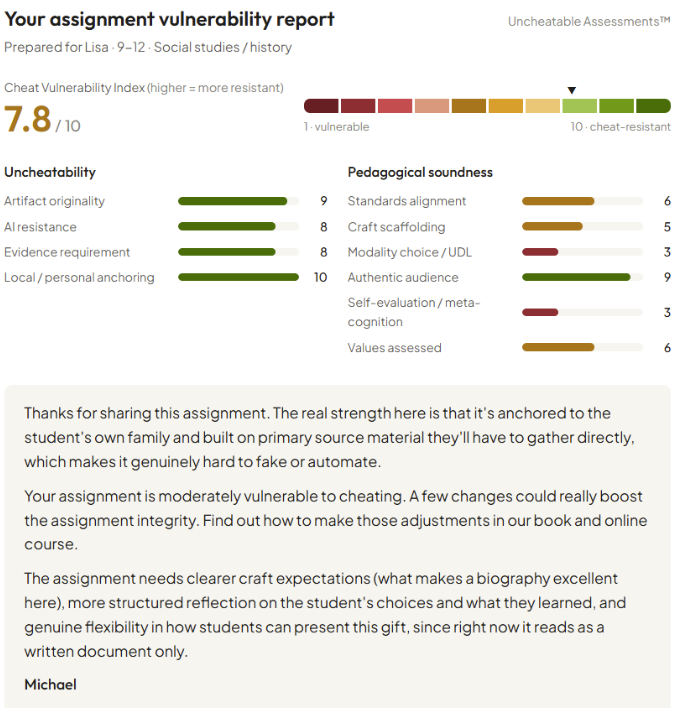
I put this assignment into Hernandez's tool too. It scored 7.8 out of 10, including a 10 for local/personal anchoring, 9 for originality and authentic audience, and 8 for AI resistance and evidence. Because students gather primary source material themselves, the feedback called it "genuinely hard to fake or automate."
It still wasn't a 10. The tool flagged clearer expectations, stronger reflection, and more flexibility in how students present their work. I had already envisioned multiple formats, but making those choices explicit would make the assignment stronger.
Uncheatable Doesn't Mean AI-Free
Here's another thing I like about Hernandez's approach: uncheatable doesn't mean AI-free. He used AI to help build a tool for creating AI-resistant assignments.
Students could use AI to brainstorm questions, organize ideas, consider formats, or get feedback. AI can help students think more deeply without replacing their thinking. The goal isn't to prevent AI use. It's to create learning students can't outsource to AI.
AI happens to be very good at the recall, regurgitation, and generic production schools have assigned for generations. Those problems existed long before AI, which is part of the argument I've made about why we need to stop romanticizing school before technology.
AI didn't create the problem; it exposed it. We can spend our energy trying to catch students and preserve outdated assignments, or we can create work students actually have a reason to do. Then educators can stop trying to detect AI and start creating better assignments.







 English (US) ·