.png)
 2 hours ago
1
2 hours ago
1
Across Big Tech, Wall Street, and other major industries, employers have pushed their workforce to embrace artificial intelligence through a mix of tactics that go beyond mere nudging, including tracking how often they are logging into these workplace tools and linking annual performance reviews to AI usage.
But at software-as-a-service company HubSpot, 100% of engineers are using AI in their workflows, which the company says has resulted in a 73% increase in the lines of code updated by its engineers. Duncan Lennox, chief product and technology officer at HubSpot, says the milestone was achieved following a three-part phased rollout that began in 2023 and didn’t depend on a mandate.
“We found mandates not to be effective,” says Lennox, who has steered the engineering, product, IT, and security teams at HubSpot since September, after holding multiple leadership roles at Google and Amazon Web Services.
The proliferation of agentic AI coding tools like Claude Code and OpenAI Codex, which are both used at HubSpot, has led to growing fears about the future of work for technologists. Even HubSpot CEO Yamini Rangan weighed in this year, sharing that she still encouraged her son to pursue a career in the field. Technology industry layoffs are up 33% for the first four months of 2026 compared with the prior-year period, according to outplacement firm Challenger, Gray & Christmas. Major tech industry job cuts have been announced at large employers including Amazon and Meta. Employment trends have been particularly bleak for computer programming roles.
But Lennox says that the biggest barrier he had to overcome when initially seeking to leverage large language models in coding was less about fear of job replacement and more about concerns around introducing errors, quality issues, and reliability.
After achieving 30% adoption for a coding copilot that was rolled out by HubSpot, Lennox and his team shared incident data that showed engineers that the work being done by teams using that tool wasn’t negatively affecting reliability versus those that weren’t. This led usage to immediately increase to 50%.
By the time autonomous coding agents gained traction, 80% of HubSpot’s engineers were using AI at work. A few other factors helped further lift interest. The company’s more distinguished engineers were the first to notice how effective coding copilots could be, leading to some internal competitiveness that inspired junior employees who wanted to keep up. HubSpot also implemented hackathon events for training, including one that’s coming up soon to train workers on how to build their own AI agents.
LLM advancements were also an external influence. Anthropic’s upgraded Opus model, which debuted in November, was particularly heralded. “That was a meaningful step forward for coding, and that causes a spike because now you can do a bunch of things you couldn’t do before because the models have gotten better,” says Lennox.
To further support HubSpot’s AI aspirations, Lennox says the company built its own customized infrastructure so that the team could read context, write code, run tests, and fix errors with autonomous coding agents. OpenAI, Anthropic, and Google are the three AI companies that HubSpot works closely with, and the team is encouraged to make swaps based on performance for various use cases. “We didn’t want 17 different frontier models,” says Lennox.
With all engineers now using AI, there’s been a spillover effect across HubSpot, which says 94% of employees use AI following a similar playbook that avoids mandates, pilots tools and then makes them accessible, as well as training events and sharing concrete proof of measurable outcomes.
Lennox acknowledges that this proliferation of AI has led to changes to how his team works. Engineers, product managers, and user experience professionals previously operated under clearly defined roles. But those lines are “starting to blur, the way front-end and back-end engineers are starting to blur as well,” he adds.
HubSpot is continuing to hire engineers, but will increase the workforce’s total headcount at a slower pace than in the pre-generative AI days. Lennox attributes the pivot more to the industrywide trend of Big Tech correcting staffing levels after overhiring during the pandemic.
Lennox declined to share his total engineering headcount, but says it’s a sizable part of the business, as HubSpot invested more than $900 million into research and development last year, or about 20% of revenue. That spending goes into the infrastructure and tooling that’s needed to build HubSpot’s platform, which is used by businesses to attract customers online through email marketing, content creation, and other tools.
For younger hires, Lennox is keen to lure AI-native engineers, those who only learned about coding with tools like Cursor or Claude Code. But, “I still want grounding in computer science and software engineering principles,” he adds.
And while AI usage has proliferated across HubSpot’s workforce, investors are continuing to pressure the company’s shares amid broader industry fears that AI will threaten the pricing models for SaaS providers. Just last week, HubSpot reported solid first-quarter earnings and a revenue forecast for the current quarter that was slightly below analysts’ expectations, and shares still cratered 20%.
John Kell
Send thoughts or suggestions to CIO Intelligence here.
NEWS PACKETS
Anthropic’s valuation looks poised to surpass rival OpenAI. The Financial Times and other outlets are reporting that the Claude maker is in talks with investors, including General Catalyst and Lightspeed Ventures, to raise tens of billions of dollars this summer at a valuation of nearly $1 trillion. That valuation, which is already being observed on the secondary markets, would vault Anthropic above OpenAI. The strong investor interest in Anthropic is due to the AI startup’s scorching annualized revenue growth, which looks poised to soon exceed $45 billion, a massive leap from $9 billion at the end of 2025. Separately, Anthropic last week inked compute deals with SpaceX and Akamai, as demand continues to swell for Anthropic’s Claude software.
Cloudflare cuts jobs as AI usage soars. Cloudflare CEO Matthew Prince says that the cybersecurity company’s usage of AI has increased by more than 600% in the last three months, changing workflows across engineering, HR, and other departments, according to a letter sent to employees that Bloomberg obtained. That led the company to announce it will trim 1,100 jobs globally, or about 20% of its workforce. On Monday, DevOps software platform GitLab also announced layoffs to shift funding to pursue more agentic AI. AI has emerged as the top cause cited for layoffs for two consecutive months, according to research from outplacement firm Challenger, Gray & Christmas. CEOs have increasingly been linking layoffs to their AI investments (so much so that there’s a dismissive term called “AI washing” to describe the trend), but it could be a bit short sighted. At Meta, as an example, there’s been plenty of AI-related layoffs and increased pressure to regularly use AI. It reportedly has made employees miserable.
OpenAI debuts new cyber model. The ChatGPT maker on Thursday unveiled GPT-5.5-Cyber in a limited preview to some cybersecurity teams, nearly a month after Anthropic caught the industry’s attention with its most advanced AI model, Mythos. CNBC reports that it will be easier for vetted teams to use GPT-5.5-Cyber for tasks like vulnerability identification and malware analysis. On Monday, OpenAI also announced that it would grant the European Union access to the new cyber model, while Anthropic hasn’t yet made Mythos available to the bloc. The Commission says it has had “four or five” meetings with Anthropic, CNBC reports, but those discussions haven’t reached the same stage that the EU is at with OpenAI.
The Musk-OpenAI trial enters its third week. The Silicon Valley case remains the center of attention, focused on a 2024 lawsuit filed by Elon Musk that accuses OpenAI of alleged deceit in taking millions from the CEO of Tesla and SpaceX while operating as a nonprofit, only to later pivot into a for-profit enterprise. Musk has also taken issue with Microsoft’s involvement and investment in OpenAI, whose CEO Satya Nadella, is set to testify this week. OpenAI CEO Sam Altman has already testified, asserting that Musk wanted control of the startup and advocated for it to become part of Tesla. The Wall Street Journal published a profile of the lawyers behind the case, while the New York Times homed in on the actions of Musk and Altman, who were once allies but now find themselves in a legal quagmire in which neither side will come out looking clean.
ADOPTION CURVE
Another task for the CIO: the AI enterprise coordinator. The vast majority of tech leaders (79%) report that their top priority is to “drive measurable business outcomes through technology,” slightly exceeding the demands they face to ensure compliance, embed cybersecurity, expand and retain talent, and transform data to enable agentic AI, according to a new study conducted by Deloitte. This represents a shift in the CIO’s responsibilities away from “keeping the lights on” when it comes to IT infrastructure and more toward rethinking workflows and data transformation.
Mercifully, this work isn’t just piling up on the CIO’s desk. Seven out of ten organizations reported that they have five or more C-suite tech leaders. The CIO title is the most common, followed closely by the chief technology officer, chief information security officer, and chief digital officer. Chief AI, data, analytics, and transformation officers are less prevalent.
Anjali Shaikh, managing director and leader of Deloitte’s global CIO program, tells Fortune that all these C-suite leaders should control different elements of the enterprise technology agenda, but that coordination should be centralized.
“The CIO’s role, or the head of technology’s role—pick your acronym—often becomes the enterprise orchestrator to make sure there isn’t a set of disconnected use cases,” says Shaikh. “Don’t let the org chart become the strategy. Really define the outcomes and have clarity around who owns what decisions.”
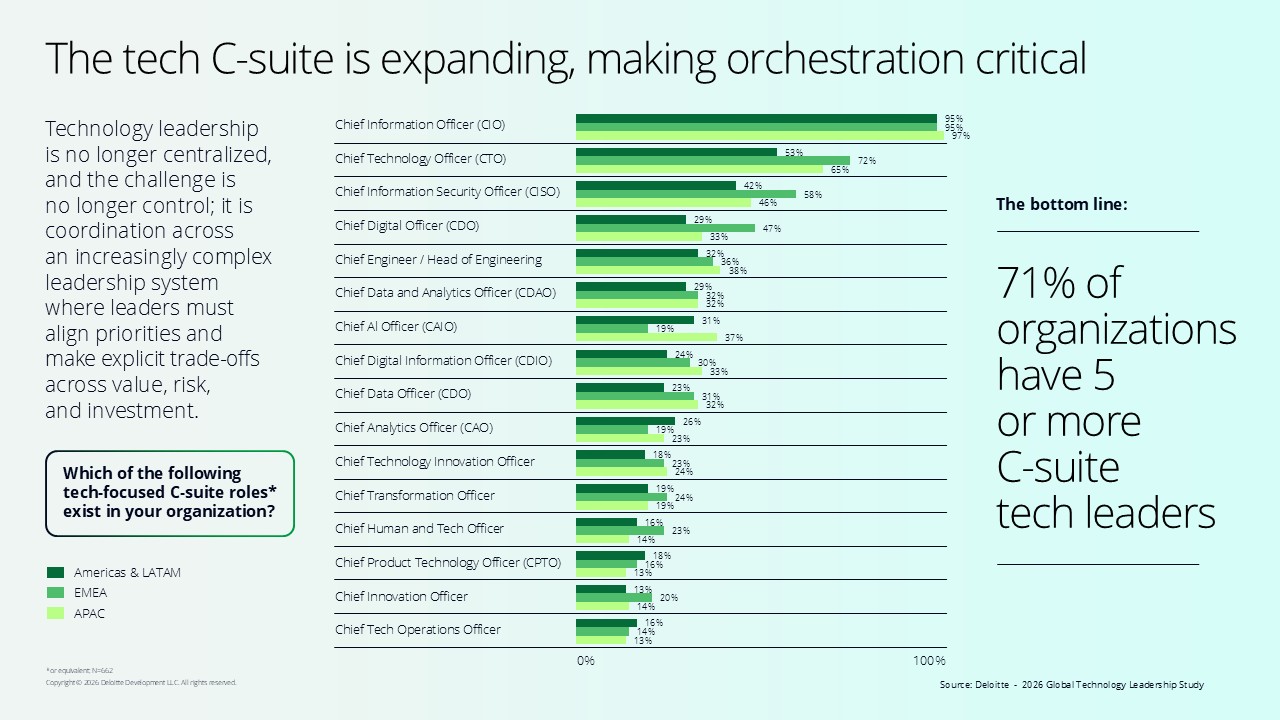
Courtesy of Deloitte
JOBS RADAR
Hiring:
- AppFolio is seeking a chief data and automation officer, based in Atlanta. Posted salary range: $240K-$300K/year.
- Zinda Law Group is seeking a head of technology, based in Austin, Texas. Posted salary range: $200K-$250K/year.
- Bellese Technologies is seeking a VP of technology, a remote-based role. Posted salary range: $240K-$260K/year.
- Wiley is seeking a group VP of technology, a remote-based role. Posted salary range: $218.9K-$328.6K/year.
Hired:
- Marqeta announced the appointment of Lukasz Strozek as CTO, effective May 18. Strozek will lead the card issuing platform’s global technology and engineering functions. He joins Marqeta from financial services company LendingClub, where he served as CTO. He also previously served as CTO of Hippo Insurance and held leadership roles at Bridgewater Associates, Bolt Financial, and SoFi.
- CohnReznick appointed Justin Ricketts as CTO. He joins the accounting firm after most recently serving as EVP and CTO at personal lines insurance provider Goosehead Insurance. He also previously served as chief product and technology officer at Sabre, CTO at Unum, and CIO at Susan G. Komen for the Cure.
- Lightspeed Commerce named Bhawna Singh as CTO, where she will lead the acceleration of the point of sale software provider’s AI roadmap. Most recently, Singh served as CTO at cybersecurity vendor Okta. She also previously served as CTO at Glassdoor.
- Massage Envy announced the appointment of Abe Hong as CTO, where he will lead the massages and skincare services company’s technology strategy, cybersecurity, and enterprise systems. Most recently, Hong served as CTP at child care and early childhood education provider Learning Care. He also previously served as CIO at Discount Tire and Red Rock Resorts.
- Code for America appointed Jonathan Porat as CTO, reporting to CEO Amanda Renteria beginning June 1. Porat will oversee technology systems and infrastructure, security, and AI at the civic tech nonprofit. He has spent his career working across federal, state, and local governments, including most recently serving as CTO for the state of California.
- Lone Wolf Technologies appointed Alan Matuszak as CTO, joining the real estate software company after most recently serving as CTO at software vendor Rectangle Health. He also previously served as CTO for nearly a decade at software-as-a-service company eLynx.
- Union Home Mortgage named Dino Lack as CIO, joining the mortgage company after previously serving as CIO and chief product officer at another lender, Caliber Home Loans.
- NextTrip appointed Brad Buice as CTO, where he will lead the development of the company’s travel technology platform. Previously, Buice served as VP of architecture and data at hospitality giant Hyatt and held a similar role at Apple Leisure Group, a luxury resort company that Hyatt acquired in 2021.
AI Playbook: Keeping up with AI's rapid evolution

AI is becoming an even more useful—and dangerous—tool as it gets smarter. Fortune AI Editor Jeremy Kahn breaks down best practices for deploying AI agents, how to protect your data from AI-powered cyberattacks, and just how smart AI can really get. Watch the playbook.








 English (US) ·