.png)
 2 hours ago
1
2 hours ago
1
ONE BIG THING
A SpaceX-Tesla union would be a giant money-loser
A SpaceX-Tesla union would be the largest merger of all time, writes Fortune’s Shawn Tully, but it still wouldn’t make any money.
The two enterprises’ valuations are about equal, Tesla’s at $1.65 trillion and SpaceX’s anticipated IPO at $1.75 trillion. To clinch the deal, SpaceX would need to issue a batch of new shares equivalent to 94% of the current number, and that would nearly double the stock from 4.1 billion shares to 8 billion. The combined SpaceX-Tesla would emerge with a valuation of $3.4 trillion.
While the $3.4 trillion valuation is breathtakingly big, the profits generated by the combo wouldn’t even qualify as small. Based on recent results, they’d be negative. At today’s numbers, a pro-forma SpaceX-Tesla would show a GAAP yearly earnings of around minus $1 billion.
- Boeing: How Kelly Ortberg is rebuilding Boeing from the inside out - Shawn Tully
- EasyJet: Castlelake Says Any easyJet Offer Would Value Airline at Minimum $4.12 Billion - WSJ
IRAN
Trump loses patience with the media’s lack of patience
President Trump lashed out at the media overnight for making negotiations with Iran “tougher” than they need to be. His comments came after he criticized CNN for characterizing his current peace proposals as not including Iran’s nuclear program. “Actually it states, very clearly, that Iran will not have a Nuclear Weapon. It then goes on, in very strong and lengthy detail, to discuss various other aspects of Nuclear. In fact, that’s what most of the agreement is about,” Trump said on Truth Social.
- Stop the “chirping”: “Iran really wants to make a deal, and it will be a good one for the U.S.A. and those that are with us. But don’t the Dumocrats, and various seemingly unpatriotic Republicans, understand that it is MUCH tougher for me to properly do my job and negotiate, when political hacks keep negatively “chirping,” at levels never seen before, over and over again, that I should move faster, or move slower, or go to war, or not go to war, or whatever. Just sit back and relax, it will all work out well in the end - It always does!” The president posted that at around 1 a.m. Eastern time.
The war goes on: The U.S. continued what Centcom called "self-defense strikes" against Iran over the weekend, the BBC reports. For its part, Iran shot down a U.S. drone over international water and claimed that it targeted a U.S. airbase. Kuwait also said it had activated its air defenses against drones and missiles.
Satellite imagery shows Iran's attacks have caused damage to 20 U.S. military sites in the Gulf region, a BBC analysis claims. Aircraft, fuel storage, hangars and anti-ballistic missile batteries have all been struck, suggesting that Iran’s military remains more capable than previously thought.
Meanwhile, the U.S. is having some success at getting ships out of the Strait of Hormuz. About 70 vessels have been successfully escorted out, according to the New York Times.
Wall Street has little visibility on what happens next
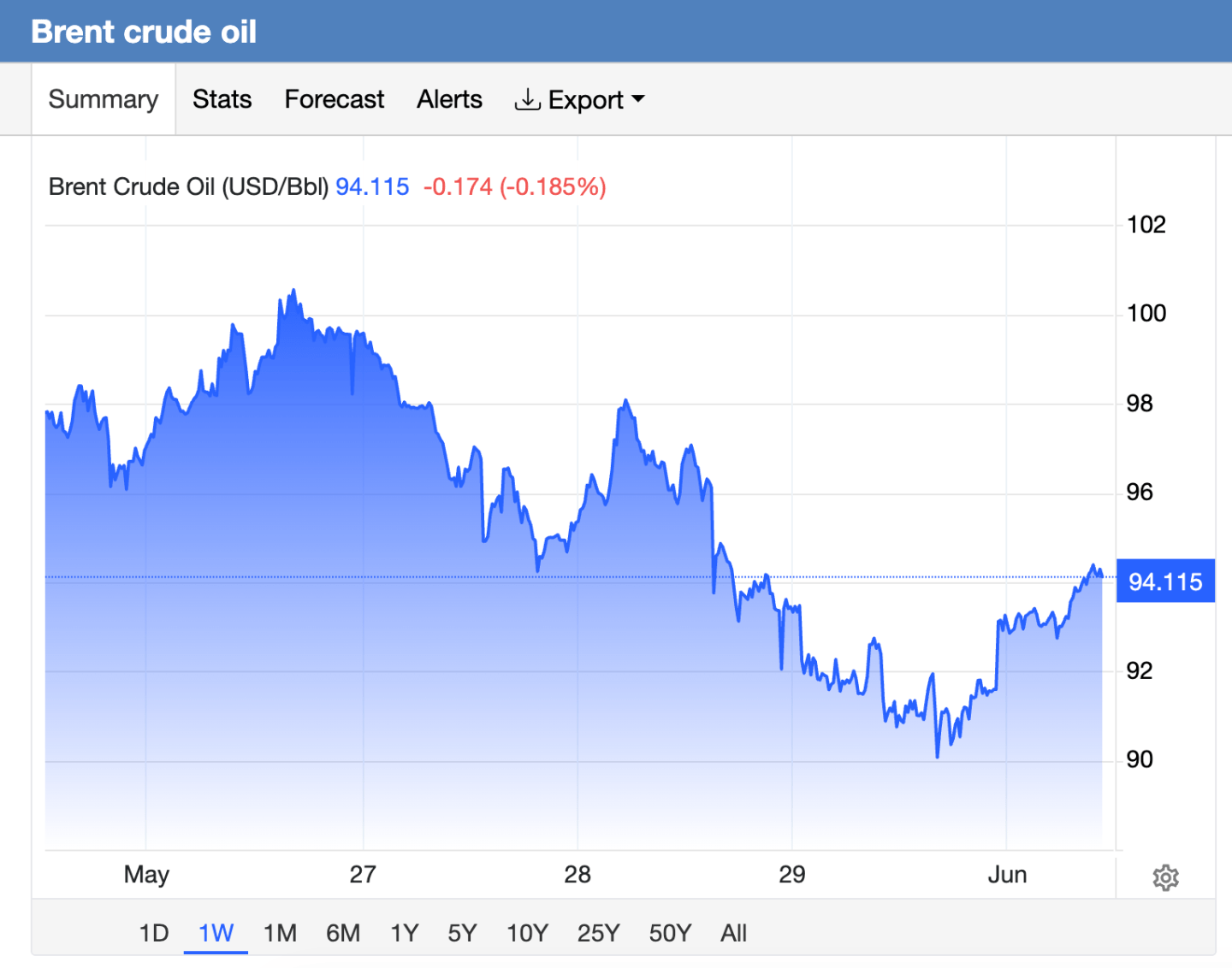
Analysts are split over where the conflict is going. The stock markets are largely ignoring the war. The price of oil has taken a step down over the last couple of weeks, to below $100 a barrel, which would imply that traders think the end is in sight. But the end keeps not happening:
- “Oil prices have edged higher on the lack of any discernible progress toward an Iran-US agreement. As with reports of an imminent deal last week, the reaction is muted. A jaded cynicism has come over investors, and in the absence of a definite statement from Iran there is a tendency to downplay comments from the US administration.”—Paul Donovan at UBS.
- “It's hard to imagine remaining in limbo for much longer given that if the Strait of Hormuz remains closed into mid-summer it will at some point likely lead to a non-linear tipping point of economic stress.” —Jim Reid et al at Deutsche Bank.
- “'Go Global' should outperform when Strait reopens … The Emerging Markets MSCI ETF (EEM) is up 25.4% ytd against 10.9% for the S&P 500. … Europe, Japan, and many EMs that are net petroleum importers should outperform when the Strait of Hormuz reopens, at least on a short-term basis.”—Ed Yardeni and Toby Hearst at Yardeni Research.
Brent crude prices via TradingEconomics:
“SOYLENT GREEN”
Hell hath no fury like a baby boomer scorned
MGM
Last week, Fortune’s Nick Lichtenberg wrote a column arguing that, economically, the baby boomers were like a pig being swallowed by a python—a demographic bulge moving through the housing and labor markets, staying longer in big houses and senior jobs, leaving less space for younger families to buy homes or move up at work. As a group, they hold a disproportionate share of the houses, high‑status jobs, and institutional power—and it’s suffocating the generations behind them.
The boomers were displeased—and they let him know it, in a series of spicy emails.
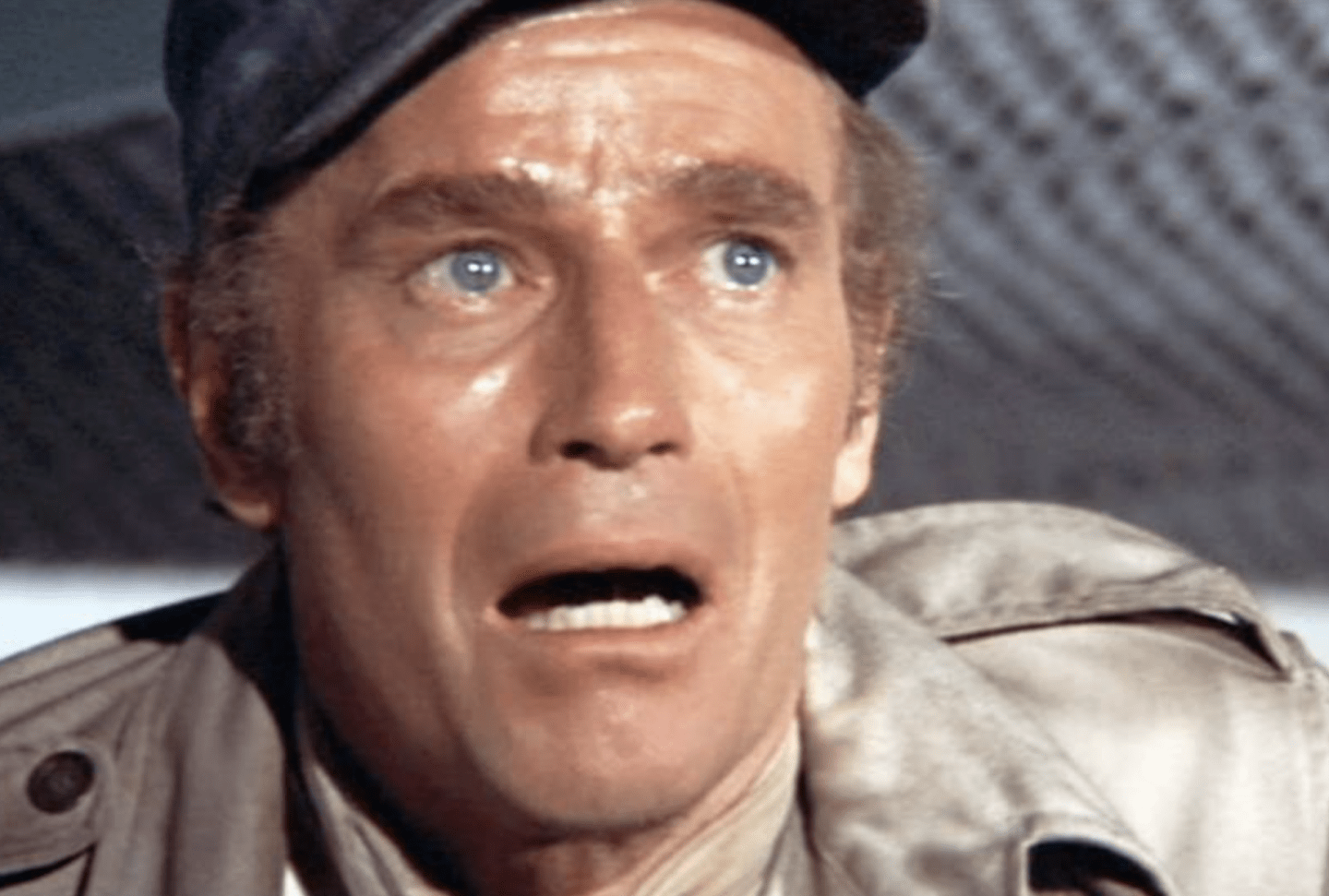
“Dear Nick,” one began. “I apologize for not dying soon enough for you, so your generation can pick over my financial bones. Sincerely, a boomer who is in excellent health (sorry).” Another wondered: “Are you suggesting putting boomers on ice floes or turning them into Soylent Green?” (A great movie if you haven’t seen it, by the way. Watch the trailer here.)
Another reader, a 73-year-old who described herself as an “old lady in Phoenix,” threatened something much tamer. “If I was your mom, I would spank you!” she said. Read more here.
MORE FROM FORTUNE
Billionaires already couldn’t talk to their grandchildren. Now they’re on opposite sides of the AI divide - Nick Lichtenberg
I worked with Steve Jobs at Apple, where every OS update killed startups. AI founders are about to face the same thing - Matt Rogers
‘Don’t be yourself’ in the workplace, actually, Columbia professor says. Here’s why authenticity is ‘overrated’ - Sasha Rogelberg
Taylor Swift just exposed a blind spot in AI law — and it’s bigger than copyright - Daryl Lim
Chinese factory activity flattens as analysts wonder about true damage from Iran War - AP
CHART OF THE DAY
The Fed could be 100 basis points off track, PIMCO says
More analysts have gone on record saying that the Fed seems to be ignoring the Taylor Rule, one of the most basic economic principles for fighting inflation: The Taylor rule states that when inflation is higher than the target rate (which is 2%), the U.S. Federal Reserve interest rate should be higher still, and moving upward faster than inflation.
In fact, the Fed’s “policy rate is 75 to 100 basis points (bps) too accommodative,” meaning too low, according to PIMCO’s Tiffany Wilding. There are various Taylor rule formulations, and on all of them the Fed appears to be holding interest rates too low to prevent inflation (CPI is 3.8%, notably higher than the Fed's current interest rate, at 3.5%), she says:
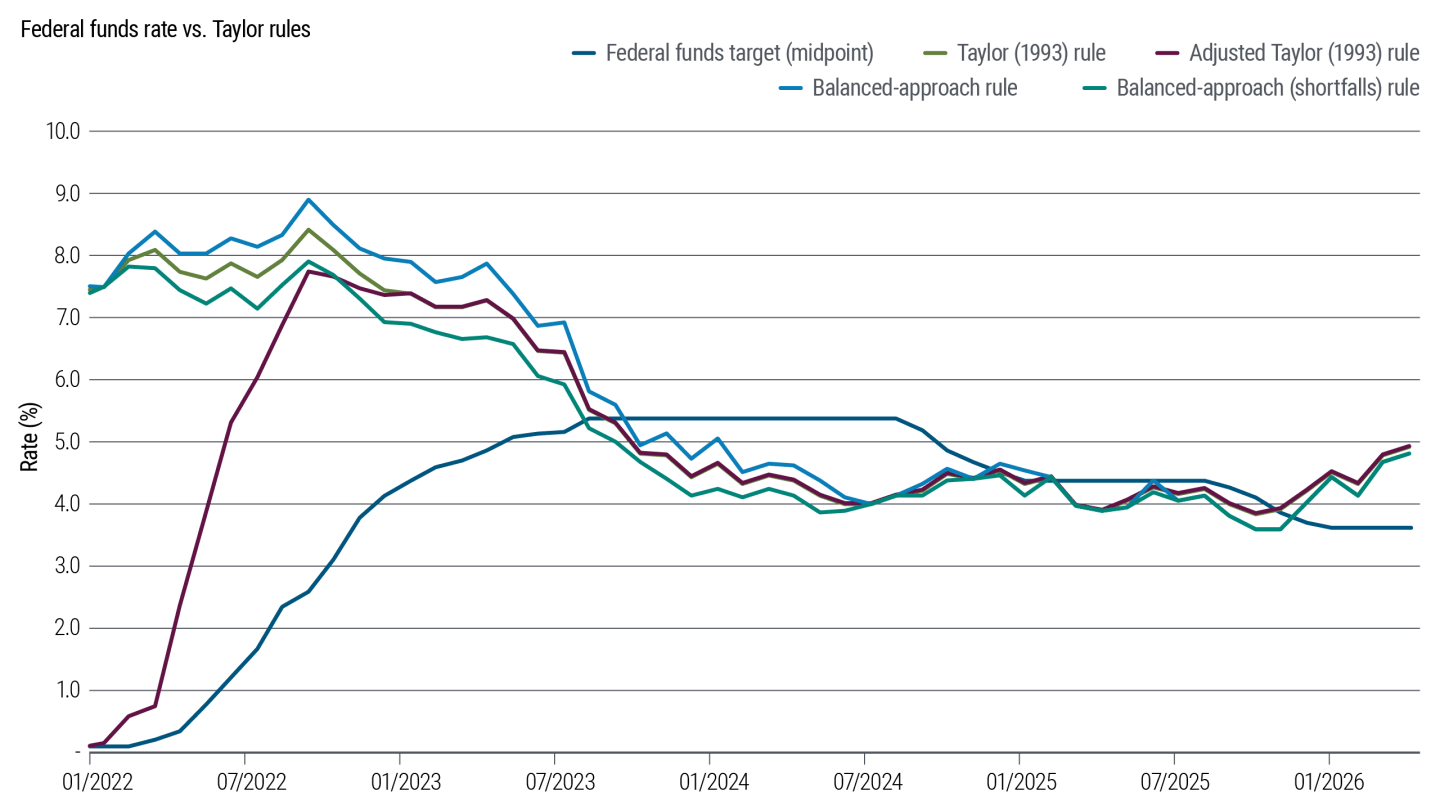
There’s “a growing risk that policy will need to pivot … in 2027,” she says. “Recent Fed communications suggest policymakers are increasingly sensitive to the risk that inflation remains above target.”
Mark Cabana and his team at Bank of America said something similar last month and they were joined by Aditya Bhave and other colleagues at BofA this weekend. “Taylor Rule models suggest policy is about 100bp too easy, based on core PCE inflation,” they told clients in a note seen by Fortune.
Deutsche Bank’s Matt Luzzetti calculated the Fed ought to be setting rates at up to 4.8%. “That is more than 100bps above the current level, given core PCE inflation of around 3.2%, an unemployment rate of 4.3%,” the bank said in an email.
- Must read: Jay Powell warns Federal Reserve is undergoing ‘stress test’ - FT
NUMBER OF THE DAY
49.8
The current rating of U.S. consumer sentiment—the lowest ever recorded—according to the University of Michigan survey. The number is so low that many analysts no longer regard it as reliable. Piper Sandler’s Nancy Lazar noted in a video last week that the survey methodology changed recently, leading to a step down in the rating, and that only about 1,000 people respond to the survey making it “very, very misleading.”
Ben Carlson of Ritholtz Wealth Management agrees. “Seriously people?!”, he says. “Consumer sentiment readings go all the way back to the early-1950s,” he says, and it is thus implausible that Americans are more miserable today than during the Covid pandemic or the Great Financial Crisis.
THE FRONT PAGES TODAY
Jes Staley to appear before Congress over ties to Jeffrey Epstein - FT
Nvidia jumps into PCs with new Arm-based chip debuting in laptops from Microsoft, Dell, HP - CNBC
Trump health readout leaves key blanks unfilled - Axios
No Raise, No Promotion: 1 in 4 White-Collar Workers Are Stalling Out - WSJ
SpaceX’s IPO Forces Wall Street to Reorganize Around It - Bloomberg
The U.S. is Quietly Guiding Ships Through the Strait of Hormuz - NYT
ONE MORE THING
At Applebee’s, revenge is served cold

Bloomberg / Contributor / Getty Images
Back in 1998, Julia Stewart was president of Applebee’s. The restaurant chain was struggling and needed to be turned around, writes Fortune’s Emma Burleigh. So Applebee’s chief exec presented a plan to Stewart: Get the struggling company back on track. “The then-chair and CEO said, ‘When you and the team turned this company around, we’ll make you CEO,’” she said.
Stewart grew sales 14% annually and the stock doubled. After three years, Stewart asked the CEO to make good on his promise. He replied, “No, not ever.”
So Stewart quit … and became CEO at IHOP.
Time passed. In 2007, she put in an offer to acquire Applebee’s. The deal went through. “I called the chair and CEO of Applebee’s, and I said, ‘Just wanted to say hi.’ And he said, ‘I was expecting this call,’” Stewart said. “And I said, ‘As you know, this morning, we announced that we have purchased, for $2.3 billion, the company, and we don’t need two of us, so I’m gonna have to let you go.’”







 English (US) ·