.png)
 3 hours ago
1
3 hours ago
1
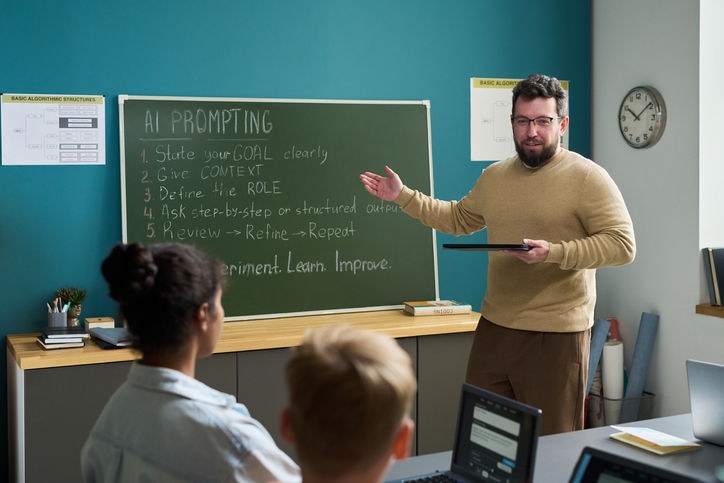
University of Central Florida professor Humberto López Castillo was recently looking at a student project when he saw that it cited a paper by Castillo himself. There was, however, a problem with this citation: Castillo couldn’t remember ever writing this paper or conducting the research it referenced.
“It was a hallucination,” Castillo says.
The student had clearly used AI, and Castillo shares the story as an example of how not to use AI in the classroom. Still, he has plenty of counterexamples.
Castillo, a trained pediatrician and professor in the Department of Health Sciences, has also seen students use AI in creative ways to promote public health understanding, and as a research tool. For one project, Castillo asks students to explain health concepts from class to non-experts, and since he started encouraging students to use AI, he’s seen the projects get better. Students have created health-themed board games and Hamilton-style rap songs. Others have designed AI to aid in health research in ways that wouldn’t be possible without the technology.
This compassionate and student-centered approach to AI use is part of why Castillo was named Superhuman (formerly Grammarly’s) 2026 Educator of the Year. The student who nominated Castillo for the award, Vardhan Avaradi, is a bioscience major, who with Castillo’s mentorship, is using AI to try to comb through massive data sets with the goal of predicting people who are at risk for cardiovascular disease.
Castillo shares some advice for other educators on how they can use AI in their classes.
Teaching With AI Effectively: Set Expectations

The first step to positive AI use in a classroom is making it clear to students when they can and can’t use the tool, Castillo says.
“Perhaps my most important advice is to set expectations up front around what is allowed, what is not allowed, what you are expecting to see, and what is a big no-no for your classroom,” he says.
He adds that at the University of Central Florida, “We have several policies on the menu that we could use. We can say, for example, ‘AI is absolutely not allowed in the classroom,’ all the way to ‘AI is absolutely encouraged in this classroom,’ as long as you specify there's a critical thinking component.”
Castillo leans toward the permissive approach but makes sure that student AI use is human-driven.
Model Proper Use
Part of encouraging proper AI use is modeling the types of uses you want to see.
For example, for a summer course Castillo is teaching in Barcelona, he is asking students to share regular blog posts. He tells students, “You may generate some content through AI, but you still have to put in your human element.” He models exactly what he means in his introduction post in which he shares photos, talks about his hobbies, and makes it clear the post was written by a human.
“Without even giving them guidelines on what their introduction post should look like, they just take that as their model, and they go with it,” he says. They can use AI to help generate their posts, “but of course they have to tweak it, and they have to provide their own input on who they are.”
Learn From Students
Castillo is not afraid to admit that when it comes to using AI in the classroom and health science more broadly, he is frequently as much a student as those he’s teaching.
“I learn a lot from students,” he says. “Teaching and learning is a two-way street, so they are teaching me new tricks, I'm teaching them new tricks on how we use AI, and it has been very collaborative.”
His students, for instance, encouraged him to use AI to code, which, with proper oversight, has been really helpful, Castillo says. They’ve also used the tool in unexpected ways, from the aforementioned projects looking at cardiovascular health to a virtual escape room in which participants had to correctly diagnose a patient with diabetes in order to escape.
Embrace Teachable Moments
Castillo has long allowed open-book tests because that is what the clinical world is like.
“I don't think real life operates like, 'We're gonna lock you down in a room without resources, and you have to produce everything from your brain,'” he says. “I'd rather make sure that you have a fair balance of the tools that are available to you.”
He feels the same way about AI, but that doesn’t mean he doesn’t have to work with students to ensure they are using AI correctly. For instance, when that student cited a paper by Castillo that didn’t exist, he met with the student.
“We sat down, and it was an interesting moment, where I was like, 'Tell me more about this paper by me that you incorporated in your reference list,'” Castillo says. The student immediately got nervous because he couldn’t provide any details since the paper wasn’t real. When the student admitted to not checking his sources, Castillo reminded him that even with AI, humans are still in the driver’s seat.
“You are the one who's responsible for that writing,” Castillo tells his students. “Your name is the only name that's going to be among the published authors, so you are the one who needs to verify those sources.”
He adds that rather than being a drawback, allowing students to make these types of mistakes with AI use in the college setting has value.
“It is a teaching opportunity," Castillo says. "This is the moment to make those mistakes."






 English (US) ·