.png)
 5 months ago
49
5 months ago
49
Soaring U.S. debt is causing Treasury bonds to lose their risk advantage over other securities, making it more expensive to borrow money, the International Monetary Fund warned.
Treasuries have long enjoyed the status as the world’s top safe haven asset. But annual budget deficits are now at $2 trillion, rapidly piling on to the $39 trillion national debt total with interest costs alone reaching $1 trillion a year.
That means the Treasury Department must issue more and more fresh debt, testing the appetites of bond investors who have already shown signs of waning demand. The result has been higher yields, with the Iran war and higher defense spending expected to worsen the debt outlook further.
“The increase in the US Treasury security supply is compressing the safety premium that US Treasuries have traditionally commanded—an erosion that pushes up borrowing costs globally,” the IMF said in a report issued this past week.
The emergency lender pointed out that the spread between AAA-rated corporate bond yields and Treasury yields has compressed.
In fact, U.S. debt is competing against a record supply of corporate debt, especially from so-called AI hyperscalers spending hundreds of billions a year, pushing Treasury yields higher.
The IMF also said the international “convenience yield” of Treasuries—meaning their safety and liquidity premium—has actually turned negative recently.
“In other words, Treasuries now offer a higher yield than the synthetic-dollar equivalents for hedged G10 sovereign bonds,” the report said.
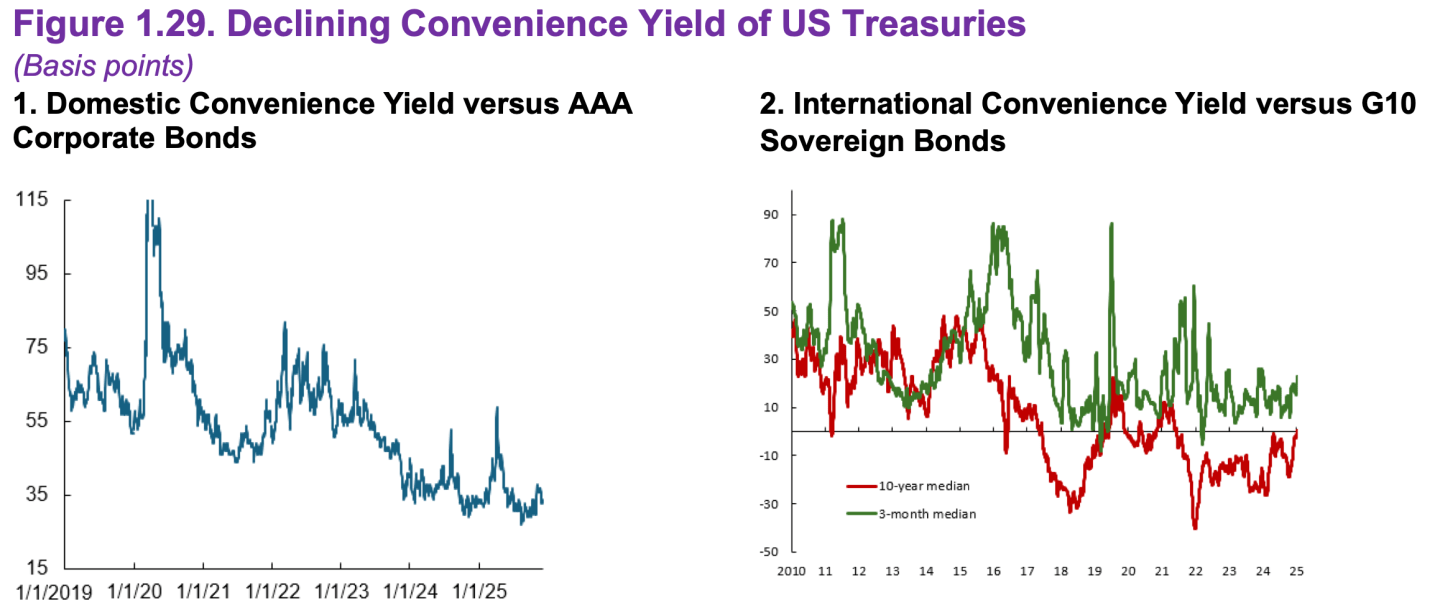
IMF
The erosion of U.S. debt’s risk advantage can also be seen in other areas of the bond market. While investors have balked at Treasuries recently, demand has surged for debt issued by sovereign, supranational and agencies (SSA) like the World Bank and the European Investment Bank.
This past week, a $4 billion auction for three-year European Investment Bank bonds drew more than $33 billion of orders, according to the Financial Times. The result was a yield of 3.82%, just 0.04 percentage points above comparable Treasuries.
And in the secondary market, SSA dollar bond yield spreads versus Treasuries have also fallen to a few hundredths of a percentage point recently.
At the same time that the supply of U.S. debt has exploded, demand has also shifted, with global central banks becoming less prominent buyers while hedge funds have taken on bigger roles.
On top of that, the Treasury Department has increasingly relied on short-term debt that needs to be rolled over more frequently, exposing it to sudden changes in market conditions.
“Hedge funds own a record-high 8% of US Treasuries, and with combined repo and prime brokerage borrowing exceeding $6 trillion, any forced unwind of these leveraged positions could send shockwaves through global fixed income markets,” Apollo Chief Economist Torsten Slok said in a note on Friday.
In the IMF’s view, the U.S. faces “inescapable” arithmetic and urged Washington to stabilize its debt trajectory by taking action on both its revenue as well as expenditures, including entitlement programs.
U.S. debt is already 100% of GDP and will top 150% by 2055 as Social Security and Medicare outlays jump, according to the Congressional Budget Office.
“The window for orderly fiscal adjustment is narrowing,” the IMF said. “Advanced economies with large debt loads need concrete, well-sequenced consolidation measures, not aspirational medium-term targets.”








 English (US) ·