.png)
 5 months ago
48
5 months ago
48
The promise was simple and seductive: pass the One Big Beautiful Bill, flood American wallets with historic tax refunds, and watch the consumer economy roar. For a few weeks this winter, it looked like it might actually work. Then the bombs started falling on Iran.
Now Wall Street has delivered its verdict. Two of the most closely watched economic research teams on the Street—Goldman Sachs and Morgan Stanley—reviewed the numbers and reached the same sobering conclusion: the Iran war’s knock-on effect on oil prices has almost entirely canceled out the biggest consumer tax windfall in years. For lower-income Americans, the ledger may be in the red.
The setup
When Congress passed the OBBBA last year, economists were genuinely bullish. The legislation—retroactive to the 2025 tax year—included no taxes on tips and overtime, a higher child tax credit, a higher standard deduction, an expanded SALT deduction, and a new senior deduction. Even the Committee for a Responsible Federal Budget, the nonpartisan think tank that generally opposes deficit-increasing legislation and has gotten into a war of words with Treasury Secretary Scott Bessent on account of its criticism, acknowledged that it would lead to a “sugar high” for the economy, boosting growth in the short term.
In late 2025 and early 2026, Trump and the White House ran an aggressive promotional campaign around the refund season. On Truth Social in February, Trump wrote that refunds would be “substantially greater than ever before,” claiming “in some cases, estimates are that over 20% will be returned to the taxpayer.” He urged Americans: “Don’t spend all of this money in one place!”
The White House formally declared in January that Trump was delivering “the largest tax refund season in U.S. history,” projecting that average refunds would rise by $1,000 or more compared to 2025. The House Ways and Means Committee amplified that figure, citing a Piper Sandler analysis projecting $91 billion in total refund growth. Early estimates pegged total consumer tax relief at $135 billion to $150 billion, with Bank of America Research projecting refunds alone running 18% higher than 2025. The theory was straightforward: put cash in Americans’ hands in the first half of the year, and they spend it.
The refunds are real. Through April 10, federal tax refunds totaled $265 billion—up 16% year-over-year—and the average check clocked in at $3,462, an 11.2% bump. Goldman Sachs estimates total refunds will end the season roughly $50 billion above last year, with additional OBBBA benefits flowing through lower tax payments, for combined relief of $75 billion to $90 billion. Not nothing. But it also isn’t enough, or what was promised.
The wipeout
On February 28, U.S. and Israeli forces struck Iran. Within days, Brent crude surged past $120 a barrel as Iran closed the Strait of Hormuz—through which flows roughly 20% of the world’s oil supply—triggering what the International Energy Agency called “the largest supply disruption in the history of the global oil market.” American gas prices, which stood at roughly $3.54 a gallon in early March, climbed to $4.11 by mid-April.
Goldman Sachs put a dollar figure on the damage: higher gasoline prices now represent a roughly $140 billion annualized headwind to household incomes. Morgan Stanley’s math is even blunter at the individual level—a sustained 15% rise in gas prices is all it takes to fully offset the average bump in tax refunds. Prices have risen nearly 40%.
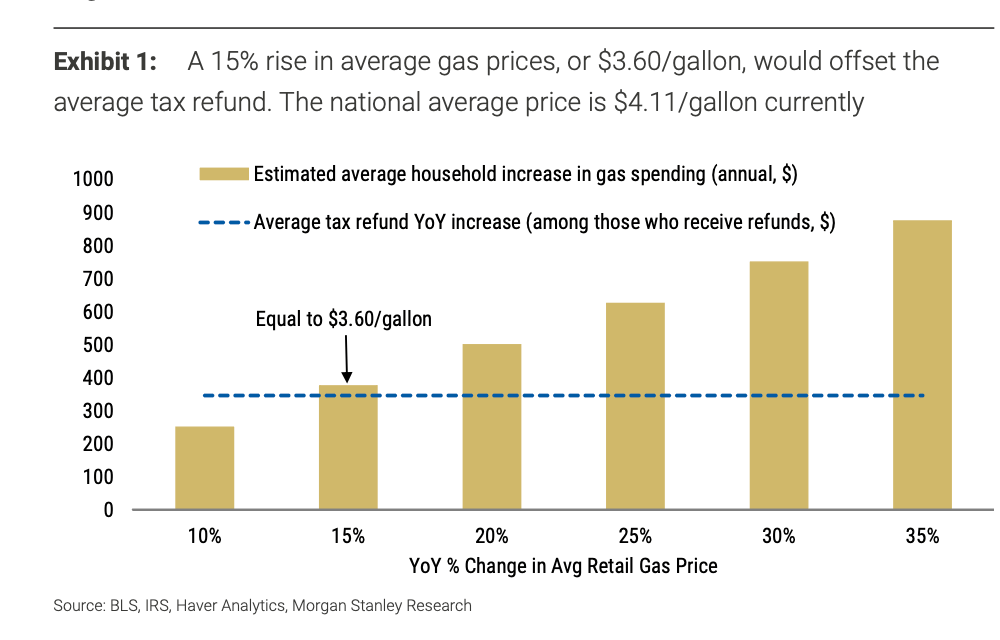
“Rising gasoline prices on the heels of the conflict in the Middle East are likely to neutralize most, if not all, of the anticipated fiscal impulse to household spending,” was the verdict from the Morgan Stanley U.S. economics team, led by Michael Gapen, something reiterated by Heather Berger, another economist on the Morgan Stanley U.S. team.
Who gets crushed
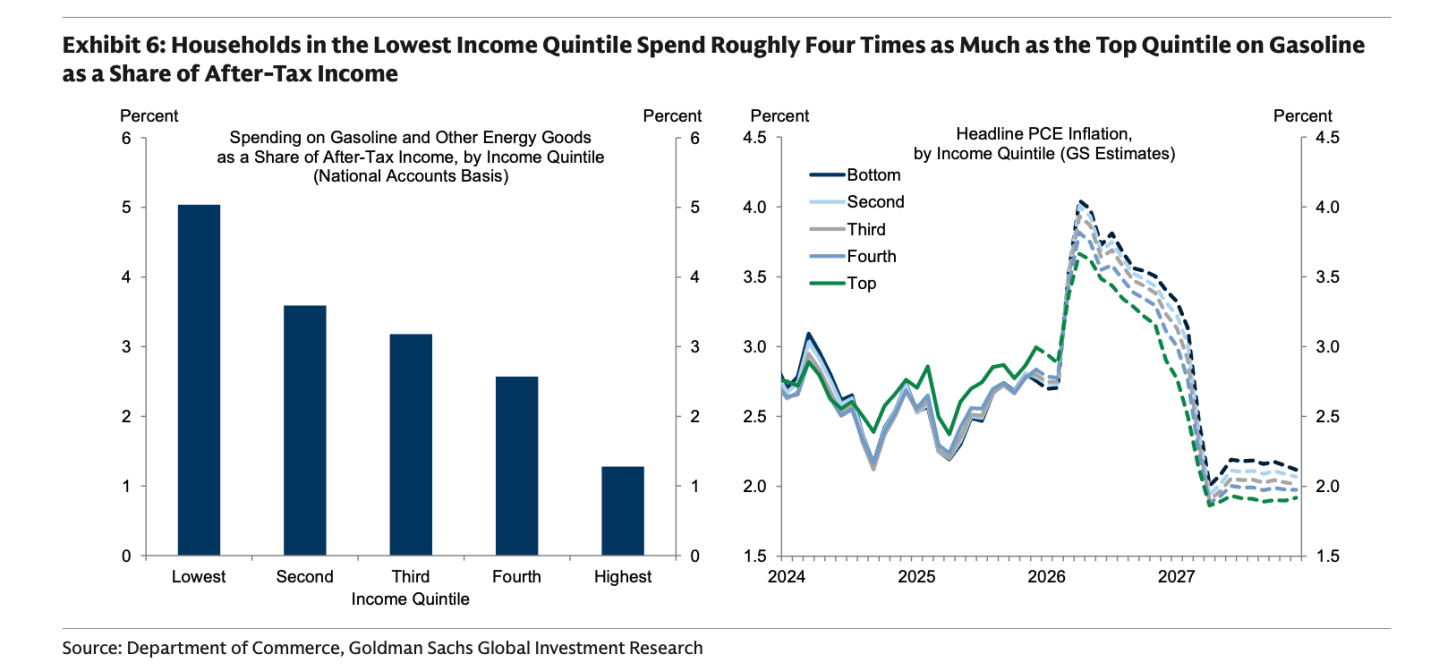
The pain is not distributed equally—and the skew is punishing. Higher-income households captured the largest OBBBA benefits through SALT deductions and bracket changes, while the gas price shock hits hardest at the bottom. Goldman Sachs finds that households in the lowest income quintile spend roughly four times as much on gasoline as a share of after-tax income compared to those at the top. Combined with cuts to Medicaid and SNAP benefits, Goldman now projects real income growth for the bottom quintile of just 0.7% this year.
Meanwhile, the ceasefire announced April 7 hasn’t fully reopened the Strait of Hormuz, and a U.S. seizure of an Iranian cargo ship last week has kept tensions—and prices—elevated. Several analysts are beginning to wonder if the Strait of Hormuz will ever look the way it used to, before the war.
Wall Street downgrades the American consumer
Both banks have revised their outlooks lower. Goldman now forecasts real consumption growth of just 1.2% for 2026 on a Q4/Q4 basis—well below the 1.8% Wall Street consensus—with the second quarter expected to absorb the worst of the oil price hit. Morgan Stanley, which already cut its GDP forecast in March and attributed 0.3 percentage points of that downgrade directly to weaker private consumption, projects personal consumption growth of 1.7%.
In a worst-case scenario where Brent averages $115 a barrel through year-end, Goldman warns overall consumption growth would fall another half-point below its already-lowered baseline—with the biggest cuts concentrated, again, among the lowest earners.
The Big Beautiful Bill was supposed to be the economic counterweight to tariff uncertainty and a tightening labor market. Instead, a war the U.S. helped start in Iran may have turned Trump’s marquee tax cut into a wash—or worse, a loss—for the very voters it was designed to reward.
For this story, Fortune journalists used generative AI as a research tool. An editor verified the accuracy of the information before publishing.







 English (US) ·